Real World Assets (RWA) in Crypto: Bridging TradFi and DeFi
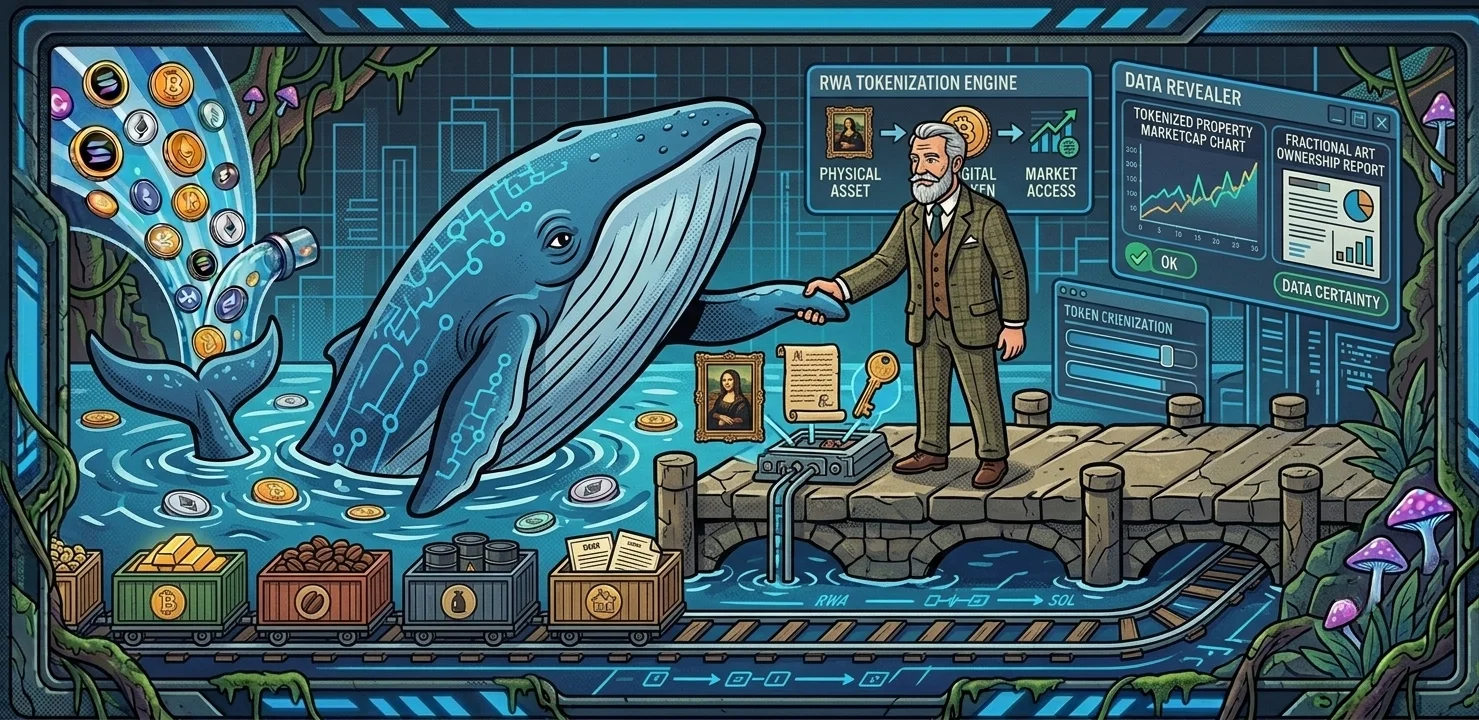
The Real World Asset (RWA) sector has transitioned from a niche blockchain experiment into one of the most credible, liquid, and heavily capitalized pillars of the cryptocurrency industry. According to comprehensive data from CoinGecko’s RWA 2026 Report, the integration of tangible and traditional financial instruments onto the blockchain is no longer just a trend—it is a fundamental structural shift.
With a total market valuation exceeding $320 billion, RWAs are successfully bringing trillions of dollars in off-chain value into the decentralized ecosystem.
The RWA Landscape at a Glance
The financial instruments moving on-chain are highly diversified, creating a multi-faceted ecosystem. Below is the market breakdown based on structural data from Q1 2026:
1. Stablecoin Dominance and Exponential Growth
Fiat-backed stablecoins continue to anchor the market with a massive $301.65 billion valuation (a 51.0% increase since early 2025). However, the momentum outside of stablecoins is even more explosive: total tokenized RWA market capitalization grew by 256.7% over a 15-month period, surging from $5.42 billion in January 2025 to $19.32 billion by March 31, 2026.
2. Cyclical Resilience Against Crypto Bear Markets
By mid-July 2026, the on-chain value of tokenized RWAs (excluding stablecoins) climbed further to approximately $34 billion, according to data tracked by RWA.xyz. Notably, this growth occurred while the broader crypto market faced a sharp correction, with Bitcoin retreating from its October 2025 peak of nearly $126,000 down to the low-$60,000s by July. This decoupling proves that institutional RWA adoption operates independently of speculative crypto market cycles.
How Does Tokenization Work?
Tokenization is the process of converting the ownership rights of a physical or financial asset into a digital token powered by blockchain smart contracts. The operational architecture generally follows three primary stages:
- Off-Chain Structuring: The underlying asset is legally isolated using a dedicated legal framework, such as a Special Purpose Vehicle (SPV). A Regulated Asset Manager oversees compliance, while a Licensed Custodian securely safeguards the physical collateral.
- Data and Valuation Verification: Independent audits and asset valuations are continuously conducted and linked on-chain, ensuring the digital token accurately mirrors the real-world value and remains legally enforceable.
- On-Chain Token Issuance: Smart contracts deploy and "mint" the digital tokens. Each token represents a direct, fractional claim or share of the underlying off-chain asset.
Case Study: Tokenizing a U.S. Treasury Bond
The tokenized treasury market expanded by 225.5%, reaching an all-time high of $12.99 billion in March 2026.
- Structuring: A regulated institutional asset manager like BlackRock purchases genuine U.S. Treasury securities and places them inside a dedicated fund wrapper. A trusted global custodian, such as BNY Mellon, physically holds the bonds.
- Issuance: BlackRock mints the BUIDL token on the blockchain, where each token represents a direct share in the yield-bearing treasury fund.
- Yield Distribution: As the physical government bonds generate interest off-chain, that accrued value is automatically distributed directly to BUIDL token holders on-chain.
Deep Dive into Core RWA Sectors
Fiat-Backed Stablecoins
While the market cap plateaued slightly in the $290–$300 billion range by mid-2026, stablecoins remain the economic backbone of DeFi. Tether (USDT) and Circle (USDC) command a combined 86.7% market share. However, market dynamics are shifting: USDT’s dominance declined from 68.9% to 61.0%, while USDC rose to 25.7%, propelled by institutional demand for highly compliant, regulated digital dollars.
Tokenized Treasuries
The sovereign debt ecosystem has evolved from a single-player sector into a fiercely competitive market. Circle’s USYC leads the segment at $3.07 billion, followed closely by BlackRock’s BUIDL at $2.88 billion. Ondo’s USDY grew to $2.15 billion, and Spiko’s EUTBL crossed the $1.01 billion mark. Additionally, institutional onboarding reached a milestone with JP Morgan’s launch of its native tokenized money market fund, MONY.
Commodity-Backed Tokens
Driven by an extended bull run in global spot gold prices, commodity tokens quadrupled from $1.43 billion to $5.55 billion (+289.1%) by March 2026. Tether Gold (XAUT) and PAX Gold (PAXG) command 87.3% of this sector. Crucially, utility has expanded beyond simple price exposure; on-chain gold spot trading volume hit $90.7 billion in Q1 2026 alone, surpassing the entire trading volume of 2025.
Private Credit Protocols
DeFi-powered corporate lending reached $2.29 billion in active loans by Q1 2026, primarily fueling emerging markets. However, data reveals heavy consolidation: while protocols like Centrifuge and Goldfinch experienced drawdowns, Maple Finance drove the vast majority of the sector's net growth by focusing its credit underwriting on institutional, crypto-native entities.
Tokenized Stocks & Exchange-Traded Funds (ETFs)
Since breaking ground in mid-2025, tokenized equities scaled aggressively to roughly $1.3 billion by mid-2026. Technology tickers dominate the on-chain stock market, led by Circle equity ($185.8 million), Micron Technology ($145.4 million), and SpaceX ($140.7 million)—the latter fueled by its historic Nasdaq IPO. Meanwhile, Tokenized ETFs reached $464 million by July 2026, led by Ondo's iShares Core S&P 500 ETF.
For investors looking to track and analyze these emerging assets, the main listing directory at CoinBazooka also features several notable RWA tokens that are highly worth monitoring. This directory provides a curated overview of the top-performing projects shifting traditional finance onto the blockchain.
The Strategic Value of RWA Tokenization
- Unlocking Cyclical-Resistant Yield: When native DeFi yields drop during crypto winter, RWAs allow capital to access stable, real-world yields (like government bonds) directly on-chain.
- Democratization via Fractional Ownership: High-barrier, high-value assets like real estate, commercial debt, and gold can be split into smaller, affordable digital fractions, allowing retail investors global access.
- Frictionless Capital for Businesses: On-chain credit architecture creates alternative liquidity channels for businesses globally, bypassing slow, rigid legacy banking infrastructure.
Structural Challenges and Market Risks
- Regulatory Complexity: Because physical assets are bound to local legal jurisdictions, RWA redemption and transfers require strict compliance, mandatory KYC/AML verifications, and regional structural isolation.
- Centralization Dependencies: Investors must trust that the centralized issuer actually maintains the off-chain reserves. To combat this, reputable issuers utilize continuous third-party auditor attestations.
- Protocol Token Performance Volatility: A critical dichotomy has emerged: while the underlying RWA assets (treasuries, stablecoins) are highly stable, the governance tokens of RWA protocols remain highly volatile. Data shows that 6 out of 7 top RWA protocol tokens recorded declines ranging from -44.7% to -98.8% over a 14-month period, demonstrating that on-chain asset growth does not automatically guarantee governance token price appreciation.
Macro Trends Shaping the Future of RWA
1. Massive Institutional Validation (The DTCC Service)
Institutional integration reached its most significant milestone yet. The Depository Trust & Clearing Corporation (DTCC)—which custodies over $114 trillion in traditional securities—received SEC approval to launch a dedicated tokenization service covering the Russell 1000 index, major ETFs, and US Treasuries. A powerhouse working group of over 50 financial giants, including J.P. Morgan, Goldman Sachs, BlackRock, Morgan Stanley, Citadel Securities, Nasdaq, and top crypto native firms like Circle and Ondo, are collaborating on this infrastructure, with live production trades scaling through late 2026.
2. Regulatory Overhauls and Legal Clearances
A clear regulatory framework has finally arrived. In the US, the GENIUS Act established federal rules for payment stablecoins, while the SEC issued its official Tokenization Statement to standardize digital securities. Furthermore, Nasdaq secured regulatory approval to natively integrate tokenized stocks and ETFs on its traditional exchange rails. Internationally, Europe’s MiCA rules are fully active, and the European Central Bank (ECB) officially integrated DLT-issued assets into the Eurosystem as eligible monetary collateral.
3. Multi-Chain Liquidity Migration
Ethereum’s historical dominance over the RWA landscape shifted significantly, dropping from a 93.4% market share down to 61.1%. Asset issuers are increasingly opting for cost-efficient alternative networks. BNB Chain (BSC) captured a 20.0% market share—largely driven by Circle’s strategic USYC deployments—while Solana’s institutional pivot expanded its RWA capital footprint tenfold to $1.01 billion (5.7% share).
Real World Assets are successfully bridging the gap between legacy institutional finance and decentralized blockchain architecture. With a market size well past $320 billion, the sector has matured into a resilient financial pillar capable of outperforming standard crypto cycles. As traditional titans like BlackRock and the DTCC build out systemic infrastructure alongside clearer global regulatory frameworks, tokenization is poised to redefine global asset distribution, liquidity, and settlement infrastructure.
Frequently Asked Questions (FAQ)
What is a concrete example of an RWA in crypto?
The most widespread examples are fiat-backed stablecoins like USDT and USDC. Beyond stablecoins, major examples include tokenized treasury funds like BlackRock's BUIDL, commodity tokens like PAX Gold (PAXG), and tokenized versions of public equities like Tesla, Nvidia, and SpaceX.
Are RWA protocol tokens a safe investment?
Not necessarily. Data reveals a stark divergence between the growth of tokenized assets and the value of RWA project governance tokens. While tokenized treasury volume hit record highs, the market value of many associated protocol governance tokens fell sharply. Investing in a protocol token carries standard crypto volatility risk, whereas holding the actual underlying tokenized RWA (like a treasury or stablecoin) offers traditional asset stability.
What blockchains are primarily used for RWA issuance?
While Ethereum remains the foundational layer for institutional RWA market capitalization, liquidity has become highly multi-chain. BNB Chain (BSC) now commands a substantial 20% of the market, while Solana, Stellar, and Aptos continue to capture growing institutional issuance volumes due to their high transaction speeds and low operational costs.
Disclaimer: Cryptocurrency trading involves high risk. Nothing in this article constitutes financial advice.